There are a lot of clinics in KL offering hair transplants. There are a lot of Instagram pages showing impressive before and after results. And there are a lot of very different price points that make it genuinely difficult to figure out who to trust.
The problem is that hair transplant surgery is not a product you can return if you are unhappy. If the result is poor, correction is possible but difficult, expensive, and limited by how much donor hair you have left. The margin for error is small, and who you choose matters enormously.
Here is a practical framework for making a well-informed decision.
Start With Credentials Not Marketing
The first filter is whether the surgeon performing your procedure is legitimately qualified. In Malaysia, hair transplant surgery must be performed by a doctor registered with the Malaysian Medical Council (MMC). This is non-negotiable.
Beyond basic registration, look for:
Specialist training in aesthetic or reconstructive medicine. Many good hair transplant doctors in KL have completed postgraduate training in aesthetic medicine and have dedicated significant clinical time to hair restoration specifically.
ISHRS membership. The International Society of Hair Restoration Surgery is the leading international body for hair restoration professionals. Membership requires meeting standards of training, case volume, and professional conduct. It is a useful indicator of serious engagement with the specialty.
Verifiable experience. Not general aesthetic medicine experience. Specific hair transplant case volume. A doctor who has performed 50 procedures is in a different league from one who has performed 500, even if their general credentials look similar.
Ask Who Specifically Performs Your Procedure
This is the question most people do not ask and most clinics do not volunteer information about unprompted.
In some hair transplant setups, the qualified doctor does the consultation, designs the hairline, and then hands over to trained technicians for the extraction and implantation. The doctor may supervise at a distance or check in periodically.
In the best setups, a qualified doctor is actively involved throughout the procedure.
Why does this matter? Because graft survival rates, implantation angle, and hairline naturalness all depend on the skill and attention of whoever is placing each follicle. These are decisions made hundreds or thousands of times per procedure. The difference between a doctor with 500 transplants of experience and an undertrained technician is not theoretical. It shows up in your results.
Ask directly: who will be performing my extraction and implantation? If the answer is vague, that is informative.
Evaluate Before and After Results Properly
Every clinic has before and after photos. Most of them show their best cases. The question is whether those cases are relevant to yours.
Ask to see results from patients with a similar hair loss pattern, similar Norwood stage, and similar hairline zone to yours. A clinic with excellent crown restoration results might not have as much experience with hairline design specifically.
Look at the naturalness of results, not just the density. Does the hairline look human? Are the angles right? Is there evidence of the pluggy or doll-like appearance associated with older techniques or poor execution?
If a clinic cannot or will not show you relevant cases, that is a signal. For context on what well-executed FUE results look like and what the technique involves, our FUE hair transplant Malaysia overview gives a clear picture.
Evaluate the Consultation Experience
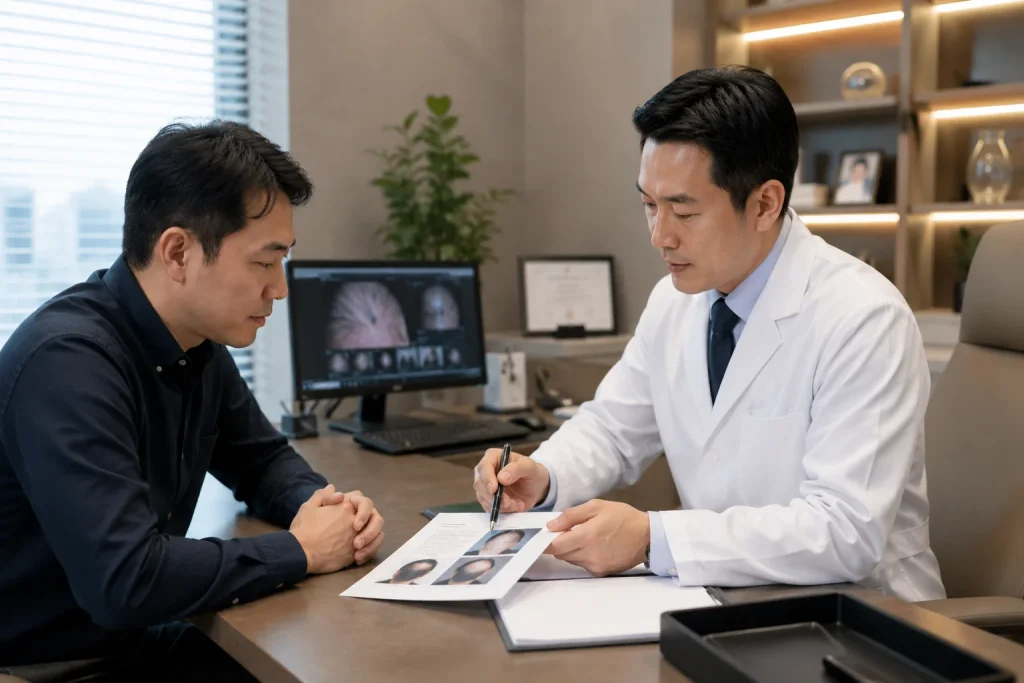
A thorough consultation should feel like a medical assessment, not a sales pitch.
The doctor should examine your scalp properly, using a dermatoscope or at least a thorough visual assessment. They should discuss your Norwood stage, the quality of your donor zone, and give you a realistic graft count estimate. They should tell you honestly whether your expectations are achievable.
If the consultation primarily involves being shown pricing packages and encouraged to book, with minimal time spent on your actual scalp condition, that is a red flag.
A good consultation leaves you feeling more informed and more realistic, not just more enthusiastic. For patients not yet sure whether surgery is the right step, our hair loss treatment overview covers the full non-surgical spectrum first, including PRP and exosome therapy.
Understand What the Quote Includes
Hair transplant pricing in KL varies enormously because clinics do not all quote the same things. Some include everything. Others quote a base procedure cost and add on medications, follow-up visits, and aftercare separately.
Always ask for a fully itemised quote that specifies:
The technique to be used
The estimated graft count and the basis for that estimate
Whether the price is fixed or subject to change based on intraoperative decisions
What post-operative medications and shampoos are included
How many follow-up appointments are included and when
Comparing two clinics based on headline pricing without understanding what is and is not included is comparing different things.
Do Not Be Rushed
A reputable clinic will not pressure you to book on the day of your consultation. This is a significant procedure with a long-term impact. You should have time to reflect, compare, and verify.
If you feel pressure to commit immediately, to take advantage of a limited-time price, or to book before the doctor’s schedule fills up, treat that as the pressure tactic it is. Good clinics have confidence in their work and do not need to rush you. Patients who also want to understand PRP maintenance post-transplant will find that covered in detail on our PRP hair treatment page.
Check Reviews Beyond the Clinic’s Own Channels
Clinic websites show curated reviews. Google reviews, patient forums, and independent medical platforms give a more balanced picture. Look for reviews that discuss the experience at 12 months, not just the immediate post-procedure period.
Be appropriately sceptical of reviews that sound overly generic or suspiciously uniform. Also be aware that some negative reviews reflect unrealistic expectations rather than clinical failures. Try to read the full picture.
Book a consultation at Nexus Clinic and experience what a thorough, no-pressure hair assessment looks like.
Frequently Asked Questions
How many consultations should I have before choosing a clinic?
At least two or three. Comparing consultations across different clinics gives you a calibration point for what a thorough assessment looks like versus a sales-focused one.
Should I choose a clinic based on price?
Price is one factor but should not be the primary one. A clinic that charges RM 8 per graft with an experienced doctor who performs the full procedure is better value than one charging RM 5 per graft where technicians do most of the work.
What does an LCP-certified doctor mean in Malaysia?
LCP stands for Letter of Credentialing and Privileging. In the context of aesthetic medicine, it indicates that the doctor has undergone the relevant assessment to practice aesthetic procedures. It is an important regulatory marker for patient safety.
Is it okay to choose a clinic in Petaling Jaya or Subang instead of central KL?
Yes. Some excellent clinics operate outside central KL. Location affects pricing due to overhead differences but not necessarily quality. What matters is the qualifications and track record of the doctor.
Can I get a second opinion on my suitability for a transplant?
Absolutely. Second opinions are sensible for any significant procedure. A confident, ethical surgeon will not be bothered by this.
How long does a proper consultation take?
A thorough hair transplant consultation should take at least 45 to 60 minutes. Anything significantly shorter should raise questions about how comprehensively your scalp was assessed.
What red flags should I look for in a clinic?
Pressure to book on the same day. Inability to clearly answer who performs the procedure. No relevant before and after cases. Pricing significantly below market rate with no clear explanation. Vague or evasive answers about technique and graft survival rates.
Are all FUE techniques the same?
No. The skill of the surgeon, the quality of the instruments, the punch size used, and the implantation technique all vary significantly and affect outcome. FUE is the method; execution quality varies widely.
Is a clinic in a hospital building more trustworthy than a standalone aesthetic clinic?
Not necessarily. Hospital affiliation can indicate certain levels of regulatory compliance but does not directly indicate hair transplant quality. The surgeon’s credentials and case volume matter more.
What should I do if a clinic refuses to tell me who performs the procedure?
Walk away. Transparency about who does the actual work is fundamental. Any clinic unwilling to answer this clearly is not one you should trust with your scalp.